

SOME HINTS ON ORGANIZATION OF THE ENVELOPMENT OF THE ENEMY DETACHMENT AND ITS FURTHER DESTRUCTION
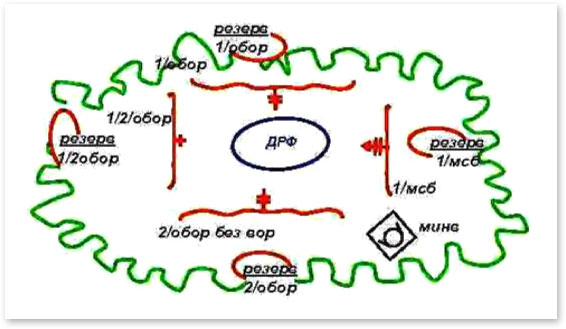
Enemy envelopment is conducted with the aim of its direct encircling, blocking of all possible retreat/escape/support routes. It should be noted that the envelopment should be carried out by concerted actions of multiple detachments or small groups. Small units operating alone usually do not have sufficient power and capabilities to carry out envelopment, except when they operate against a small concentrated enemy group.
The main purpose of planning, preparing and conducting the operation is the complete envelopment of enemy forces in the area. Performing it at night allows to achieve maximum stealth and surprise, which provides an undeniable advantage.
Movement must be carried out quickly and rapidly; to block the enemy's escape routes, groups (subgroups) occupy positions simultaneously. If it is not possible to take positions at the same time, then first of all it is necessary to block the most likely ways of enemy’s retreat.
The initial deployment at forward positions is the most critical stage of the operation. If the enemy becomes aware of envelopment attempt, it probably should immediately try to find unprotected passages in blockading ring or try to strike at the weakest points in order to break through the encirclement.
To prevent the enemy’s breakthrough and to block its escape routes, avantgarde formations of the encircling detachments, as a rule, should consist of most experienced and capable combat groups. Mobile reserves are positioned in such a way to repeal any breakthrough attempt and to support forward detachments at difficult terrain areas, such as gorges, caves and tunnels.
Artillery fire support can help to conceal the envelopment plan by distracting the attention of enemy forces until the surrounding detachments advance to enemy positions. Artillery support should be carefully planned to able to continue support of attackers’ actions when the enemy becomes aware about the envelopment operation.
Tightening the envelopment ring
After the initial encirclement, fire and maneuver are used to tighten the envelopment ring.
When, depending on the terrain, the encirclement line may be reduced, it is possible to withdraw some units from the contact line to the reserve. In the case of actions against small enemy forces, the entire encirclement zone can be cleaned by simple compression, but in the case of actions against significant forces, other methods will be required (Fig. 1).
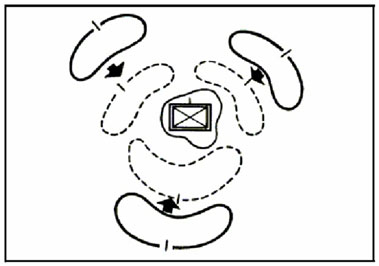
Fig. 1. Tightening the envelopment ring
Another method used after tightening is to place blocking forces in one or more directions, while other detachments force the enemy to retreat. This method is effective when blocking forces can take positions on terrain with natural obstacles or directly behind them.
Destruction of the enveloped enemy
The "Hammer and Anvil" maneuver
According to this method, one or more units performing envelopment keep their positions, while the remaining forces push the enemy towards them (Fig. 2).
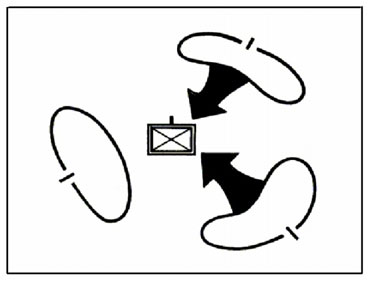
Fig. 2. "Hammer and Anvil" maneuver
The “Wedge” maneuver
This method is used after the final envelopment of the enemy. One unit is used to split up the enemy forces, while the rest of the units remain in their positions. After the enemy's forces are fragmented, the encirclement ring is tightened, or the "Hammer and Anvil" method is used (Fig. 3).
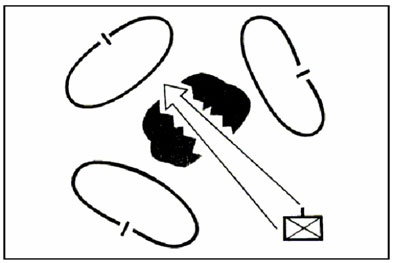
Fig. 3. The “Wedge” maneuver
Published: 28/05/23