

The introductory part of the publications of the mining/demining expert, representing the main features of an old, but not obsolete profession.
INTRODUCTION TO THE MINE WARFARE OF OUR CENTURY
(using the example of the current war in Ukraine)
INTRODUCTION / INTRODUCTION - Part 2
A glance at the battlefield terrain in Ukraine except towns and settlements shows mainly a plain, intersected by rivers. Some places are mildly rugged by natural hills or “artificial” (heaps). Basically, these are endless fields, cut into rectangles by dense forestation ribbons. Such terrain has always been advantageous for a wide front conducted by large concentrated armies, especially so-called “armour fists”.
However, new times require new technique and new technologies. Oddly enough, both sides of the conflict did not immediately come to a new tactic of warfare.
The importance of engineering support in the organization of defense is extremely difficult to overestimate. Various fortifications, trenches, dugouts, and, of course, barriers - both explosive and non-explosive types. Laying mines at possible routes of the enemy advance, both in front and on the flanks of the frontline positions, as well as remotely controlled and “old-tech” minefields at the most threatened places behind positions are never superfluous to prevent a possible enemy breakthrough.
It should be noted that the so-called “multilayer mining” was extensively used in military conflicts of the late 20th and early 21st centuries – but, oddly enough, many times came as a surprise in ongoing war. The data obtained from open sources, even sometimes contradicting, demonstrates numerous examples of this general trend. It is enough to recall at least the Ugledar direction.
On January 9, 2023, the Russian MoD announced that Ukrainian forces were concentrating a large group of troops in the western part of the Donetsk region in the Ugledar area as a preparation for new offensives. On January 24-25, Russian troops began the assault of the city, and the next day, Russian officials announced that troops had entered the city and were trying to gain a foothold on its outskirts. During the offensive on Ugledar, which was defended by 72 OMBr, Russian forces, namely the 155th and 40th Marine Brigades, suffered heavy losses. Previously, in November 2022, the military of the 155th brigade reported in a Telegram that the commander was sending soldiers to poorly organized assaults of Pavlovka near Ugledar, as a result of which the brigade lost 300 people and 50% of equipment in 4 days. The videos that recorded the outcome of one of the clashes in February 2023 showed 13 destroyed tanks and 12 infantry fighting vehicles (about half of the composition of the tank battalion of the Russian Federation). On February 10, there were reports of the possible destruction of more than 30 armored vehicles and heavy losses in manpower under Ugledar.
The Ukrainian military mined all the nearby fields, leaving only dirt roads untouched. During the battle, Russian troops moved in tank columns, along dirt roads, just like at the very beginning of the war. Ukrainian tanks, as well as anti-tank crews armed with Javelin and Stugna-P ATGMs, operated from ambushes and maneuvered in forests. After the anti-tank crews knocked out the lead and closing vehicles, M777 towed and the CAESAR self-propelled 155-mm howitzers hit the column; in one case the HIMARS battery also was engaged. Trying to turn around, Russian tanks drove into a minefield, were blown up and became an obstacle for other vehicles of the column, finally closing the trap. This way the Ukrainian military repelled several waves of attacks.
Russian efforts to equip defense lines before 2023 summer campaign including so-called ”dragon's teeth” and other defensive structures on the so-called “Surovikin Line” were widely (and proudly) covered in official media. The Ukrainian side, on the contrary, mocked these news and showed videos of their armoured vehicles easily overcoming obstacles during training.
However, in reality, the very presence of anti-tank fortifications forces the enemy to change the direction of attack, and well-fortified lines require less personnel and equipment for defense. However, the real effectiveness of the fortified line depends on many factors, including number of lines, artillery, placement of minefields and other things. Such fortifications can be destroyed by sappers or targeted fire, as well as shifted by tanks.
Ukraine has military vehicles for dismantling defensive fortifications: media reported some captured near Kherson, and earlier, Germany pledged to transfer the Pionierpanzer 2A1 Dachs tracked vehicles. The experience of the wars of the twentieth century shows that with proper planning and under certain conditions, the attackers can simply bypass the fortifications or break through them in a narrow area.
After very short time the Ukrainian counteroffensive just mirrored the faults demonstrated by the Russian military. Russians learned lessons from their mistakes, near Kharkov, Izyum and Ugledar. Without taking this into account, the Ukrainian forces just “rushed through” to get stumbled upon the echeloned defense of the Russian forces - most importantly, well-prepared minefields that made offensive on a broad front impossible. There were two options left and both were tested: the first one is armour spearhead through minefields which resulted in painful losses; the second is infantry small groups infiltration attempts through minefields.
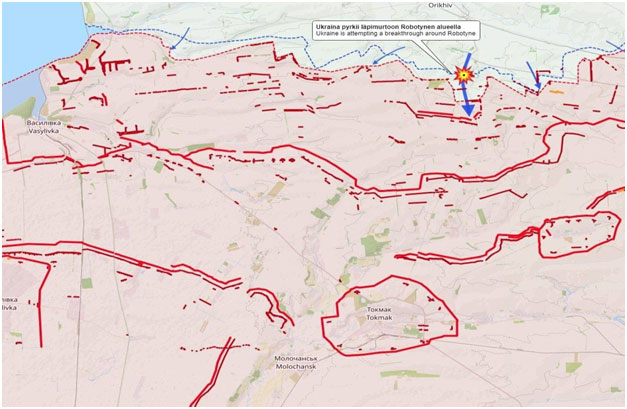
Russian defence lines, southern direction
Taking into account Russian UAVs and artillery, as well as the complete dominance of Russian aviation in the air, both options were physically impossible to implement without huge losses. The Ukrainian command did not take into account the fact of dense mining of fields. This neglect of the basic truths taught in military academies - that is, the fundamental components of defense engineering - forced the advancing Ukrainian troops to move along the roads. Russian aviation and artillery struck at columns, while Ukrainian tanks and armored vehicles fell into mine traps, thus mirroring Russian mistakes.
According to the Ukrainian serviceman, Russians “stuck ATGMs under every bush”; accompanied by Ka-52 and Mi-28 attack helicopters, they staged a real hunt for Ukrainian armored vehicles.
According to the former commander of the Polish Army, General Waldemar Skrzypczak, the "mine war" is raging on in the Zaporozhye sector of the front. "The way the Ukrainians are trying to overcome the minefields shows that the crews were poorly trained to perform this task. It was reported that tanks were sent forward as a battering ram. However, without cover, they become an easy target for Russian soldiers armed with anti–tank weapons." During a frontal attack south of Malaya Tokmachka, the Ukrainian forces lost five vehicles, including specialized Leopard tanks designed to lay passages through minefields and fortifications. Like bulldozers, they are equipped to dump the earth, pushing the mines away. “The Russians have filled the ground with thousands of mines, their minefields extend hundreds of meters deep. We have seen for several months that the Russians are mining like crazy. Mines placed in the spring are no longer detectable today. Despite the fact that mining was known in advance, the right tactics for overcoming minefields were never developed.“ According to General Skshipchak, all of the abovementioned slows down the pace of the offensive in Zaporozhye, while Ukrainians are expected to make a decisive breakthrough. He believes that the Ukrainian troops have not yet reached the main lines of Russian defense, while the Russian segment of Telegram publishes more and more photos of destroyed Leopard MBTs.
Minelaying in frontline zone has certain peculiarities. Most important of which is huge number and high sophistication of explosive traps placed in minefields. The data published by Russians indicates also ghe unpredictable character of minelaying conducted by Ukrainian forces.
Both sides actively use remote mining engaging proven mine delivery systems, such as: special cluster munitions for various MLRS ( “Smerch”, “Uragan”, HIMARS), artillery systems “Msta“, “CAESAR“, M-777, as well as new systems. For example, the APU began to use American M70(73) type anti-tank mines, delivered by 155-mm shells (a shell submunitions spread over the terrain up to 600 meters around the aiming point); RAAMS (The Remote Anti-Armor Mine System). Russian Army uses a new “Zemledeliye” system (122 mm MLRS with two packages of 25 rockets equipped with mines of various types on KAMAZ wheeled chassis; the firing range is from 5 to 15 km, which allows you to quickly cover any direction with minefields) and a “Klesch “ (on a tracked (270 cassettes) and wheeled (60-180 cassettes) chassis.
As reported, “Zemledeliye” system managed to create "mine bags" with an area of about 300 thousand square meters both in front of the columns of Ukrainian troops as well as at their retreat ways, thus increasing damage to vehicles and manpower dramatically.
Citing the opposite party, in the words of one of the Russian sappers: "In general, modern mine warfare is never like the previous ones. The creativity of an expert is limited only by his imagination, and an ordinary infantryman is rarely ready for such a thing. For example, an anti-personnel mine is layed, a heavy anti-tank mine is placed under it, and there is a pit with high-explosive ammunition at the bottom. It is almost impossible to neutralize this, and no vehicle can survive it. The crew is literally left with nothing but ashes."
Literally everything that is possible is mined. Abandoned equipment, weapons, ammunition, bodies of the dead, entrances to buildings, dugouts, as well as household items. Therefore, at all the sites taken under control sappers enter first to secure them.
Ukrainian ccounteroffensive is not over yet, and with considerable reserves there will be new strikes on new directions. After collapse of Kakhovskaya HPP, and the fact that water from the Kakhovsky reservoir flooded and actually washed away both protective structures and minefields in lower Dnieper, the next strike can be expected there. Neither side has data on where the mines are located, at what depth, in what condition they are. Those mines that remained in place are covered with a thick layer of silt and mud, which means that they can work both at the first and at the tenth passage of armored vehicles (there are cases when the mine “missed” a tank minesweeper trawl (3 tons) and triggered under the tank itself (more than 40 tons)). That is, minefields become unpredictable, which should be taken into account by both sides.
The war continues. Its outcome depends on numerous factors: plans, availability of resources, reserves, weather conditions, and, in particular, how effective the “mine war" will be.
Published: 03/07/23