

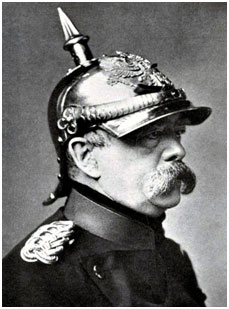
Armenians have almost monopolized the definition of "the most" relating to both the lauded achievements and shortcomings. But let's see what said about his people, national character and political system the founder of the Second German Empire Prince Otto von Bismarck.
The conservative and reactionary, who used hitherto unprecedented moves and techniques in diplomacy and domestic politics.
The diplomat, much more disciplined and structured than most of the Prussian generals of his time.
The guardian of ancien régime, who supported the most modern education system.
Neither the left nor the right-wing politicians liked him, nor even his own mates – because none of them passed the test of history - while he steadily achieved his goals through hard work and with limited opportunities.
The bitter criticism of a century and a half ago is absolutely modern today in relation to our country - the "Iron Chancellor" never quit the hard work, accepting the weakness of the human race, and choosing action to complaints and excuses.
Well – isn’t it time to stop to complaint and go to work?
THE MAN & THE STATESMAN
Being The Reflections and Reminiscences of OTTO, PRINCE VON BISMARCK
HARPER & BROTHERS PUBLISHERS, NEW YORK AND LONDON, 1899
HUMAN, TOO HUMAN
It is only human nature to be more keenly sensitive to the thorns than to the roses of every institution, and that the thorns should irritate one against the existing state of things. (p.14)
Princess Augusta preserved from her youthful days at Weimar to her life's end the impression that French, and still more English, authorities and persons were superior to those of her own country. She was of true German blood in one way; in her was verified that national fashion of ours most sharply expressed in the phrase, 'That does not come from afar, so it is good for nothing.' In spite of Goethe, Schiller, and all the other great men in the Elysian Fields of Weimar, that intellectually eminent capital was not free from the nightmare that until the present time has weighed upon our national sentiment, namely, that a Frenchman, and in the fullest degree an Englishman, by reason of his nationality and birth is a superior being to a German; and that the approbation of public opinion in Paris and in London constitutes a more authentic proof of our own worth than does our own consciousness. (pp. 132-33)
It will surely be thought that grievous misrule had so embittered the people against the authorities that the flame was ready to burst forth at the first breath. Political unripeness has a good deal to do with this stumbling over mere threads ; but during the last fourteen years we have been teaching the nation a taste for politics without satisfying its appetite, and it has to seek its nourishment in the sewers. (p. 268)
There is not one of us who does not think that he knows better about everything, from managing a war to picking fleas from a dog, than all the learned specialists; while in other countries there are many people who admit that they know less about some things than other people, and are therefore ready to give in and keep silence. (p. 288)
ARMY
I can see no means of safety whatever, unless the Lord our God help us. In the process of universal dissolution I can recognise only one organism with any power of resistance, and that is the army. To maintain this untainted is the problem which I regard as still soluble, but certainly only for a short time. It too will become plague-stricken if it does not get to action, unless healthy air is breathed into it from above, and that too becomes more difficult every day. (p. 272)
DIPLOMACY
In purely Prussian civil-diplomats, who have never, or only inadequately, come under the influence of military discipline, I have as a rule observed too strong a tendency to criticism, to ' cocksureness,' to opposition and personal touchiness... Moreover, in diplomacy there is this to be considered, that those among the aspirants who possess means or a chance knowledge of foreign languages (especially of French) regard those very circumstances as a ground for preference, and therefore make more claims upon those highest in authority and are more inclined than others to criticise them. An acquaintance with languages (after the fashion in which it is possessed even by head-waiters) was with us readily made the basis for a belief in diplomacy as one's vocation… (pp. 4-5)
BUREAUCRACY
To glance at a comparison with present conditions, it had been hoped that the state authorities would have been relieved of business and of officials by the introduction of the local self-government of to-day; but, on the contrary, the number of the officials and their load of business have been very considerably increased by correspondence, and friction with the machinery of self-government, from the provincial councillor down to the rural parish administration. Sooner or later the flaw must be reached, and we shall be crushed by the burden of clerkdom, especially in the subordinate bureaucracy. Thus self-government means the aggravation of bureaucracy, increase in the number of officials, and of their powers and interference in private life. (pp. 12-14)
PUBLIC / POLITIC
The daily current which then roared its loudest in the press and in the parliaments imposed upon people as being the voice of public opinion; but it affords no measure of the people's mood, upon which depends the readiness of the masses to render obedience to the demands made upon them by the authorities in the regular way. The intellectual power of the upper ten thousand in the press and the tribune is sustained and directed by so great a multiplicity of conflicting efforts and forces that governments cannot adopt it as a clue for their conduct, so long as the gospels preached by orators and writers, by virtue of the credence they find in the masses, do not command the use of material forces close packed in a limited space. If this is the case, a vis major comes upon the scene, and politics have to reckon with. So long as this effect (which as a rule is slow in coming) does not occur, so long as the noise is made only by the shrieking of the rerum novarum cupidi in the greater centres, and by the emotional needs of the press and parliamentary life, then, so far as the politician of realities is concerned, Coriolanus' opinion of popular manifestations holds good, although no mention of printer's ink is made in it. (p. 67)
The draft of the Address calls this a great period; I have found nothing great here but personal ambition, nothing great but mistrust, nothing great but party rancour. These are three greatnesses that, in my opinion, stamp this age as petty, and afford the friend of his country a dismal glimpse into our future… (p. 78-79)
…it did not depend so much upon the convictions of the whole as upon the authority which the acknowledged leaders in each group generally hold - and not unjustly, for, as a rule, they are the best speakers, and usually the only hard-working men of business, who save the others from the trouble of studying the questions which come up. One of the less regarded members of the group, if he attempts opposition, is easily put clown by the leader of the group, who is generally a readier speaker, in such a way as for the future to take from him all desire for revolt… (pp. 155-56)
In the parliamentary groups the ambition of the leaders, orators, and ministerial candidates found nourishment, and took shelter behind the national ill-temper. (p. 298)
Men were too much preoccupied with public opinion, speeches, newspapers and constitution-mongering to arrive at decided views and practical aims in the domain of foreign, even if it were only extra-Prussian - German, policy. (p. 77)
We confessed that we required the testimony of other Powers in order to look upon ourselves as a Great Power… The revelation that Prussia was a Great Power had been previously recognised on occasion in Europe, but it was weakened by long years of cowardly policy which at last found expression in the pitiful part played… (p. 305)
Published: 12/05/23