

TANK OF THE FUTURE
Armata – the tank which launched a new spiral of the tank building race
The T-14 Armata tank1 was created by the Ural Design Bureau of Transport Engineering and was first introduced in 2015. Armata is a vehicle for reconnaissance, targeting and fire control for the escort of its tactical link - a self-propelled artillery howitzer, an anti-aircraft missile system and T-90 tanks. Armata tracked platform has an uninhabited turret placed with a 125mm gun with an automatic loader (in the future – a 152mm gun), a remotely controlled turret with a 12.7mm Cord machine gun. The tank is protected with fourth generation Malachite dynamic armor and a new version of Afghanit active protection system. The medium-range 360⁰ Doppler radar with an active phased array antenna, 360⁰ high-resolution UV cameras capable to detect vehicle engine exhaust, as well as a Pterodactyl reconnaissance UAV with its own surveillance radar (radar) and infrared sight provide extended surveillance capabilities.However, full-fledged serial production of the T-14 has not yet launched, which may indicate the need to eliminate still existing problems and shortcomings.
It should be noted that in the summer of 2020, the Research and Testing Institute of Armored Weapons and Equipment (НИИИ БТВТ) introduced the concept of a future tank with a two-link structure, which allows to solve the problems of growing weigh and size.
The forward combat module has a control compartment - an armored capsule for three-men crew. An uninhabited turret will be armed with an electrothermochemical cannon with automatic loader, as well as active protection system modules, a blinding laser device and an electromagnetic pulse generator. The second link of the tank will house a 3000 thousand horsepower gas turbine engine, a magazine of self-homing missiles with a range of up to 12 km, as well as containers with aerial and ground unmanned reconnaissance and protection vehicles2.
Above all, the activity of tank designers and experts in the West was dramatically accelerated by sharply increased effectiveness of anti–tank weapons - first of all, missiles carried by drones and corrected ammunition, as well as kamikaze drones. Experts from various think-tanks presented their views on possible ways to solve the problem.
Very interesting article Beyond The M1 Abrams3 begins with an excursion into the lessons of the Second Karabakh War and says "... everyone we talked to, from retired Army tankers and industry experts to drone-loving futurists, agreed that manned armored vehicles of some kind will still have a place in future wars. Why? Human soldiers will still need a way to move about the battlefield under armor protection, and they’ll need it even – or especially – when killer drones swarm the skies."
___________
Here are some of the most interesting predictions:
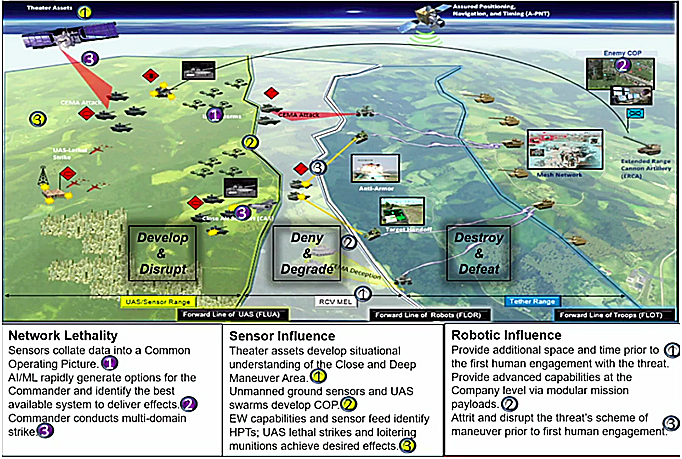
- The M1 should not be replaced by a new tank, but rather by a whole family of various manned and unmanned vehicles, jointly operating by wolf pack network principle (researched as part of the Army's Robotic Combat Vehicle program4).
- since the decisive clash often occurs before the visual contact of the opposing sides, the main burden of the tasks will be assigned to ground robots, UAVs and long-range missiles; the role of armored vehicles will shift towards command and control platforms in a distributed network of air and ground sensors, unmanned aerial vehicles and robotic armored platforms.
- in practice, this may mean disaggregating the combined capabilities of the tank to components of a modular combined-arms complex combining ground robots, UAVs and a platform with a crew, “that can pull intel from space when needed, seamlessly call in backup fires, coordinate its own beyond-line-of-sight targeting, and rely on automation in targeting and navigation to multiply the effectiveness of the human crew”.
- more moderate experts mention a heavily armored vehicle with a powerful cannon, accompanied by a swarm of reconnaissance, strike and transport ground and air drones. A crew is still required because a neural network or an advanced artificial intelligence algorithm is still unable to make intuitive decisions based on prolonged experience and the involvement of all human senses, and is still vulnerable to hacking, jamming, or other disconnection.
Robotic Warfare Battlefield Geometry
This view is shared by Russian experts who point out:
- the tank is the only combat vehicle capable to maneuver and to shoot under enemy direct fire;
- the tank is capable to destroy any target within the line of sight range with shells and guided missiles;
- the tank’s situational awareness and command controllability can be improved and extended by a set of reconnaissance micro-drones;
- automation and robotization will allow to reduce the crew to two people;
- mixed tank formations from crewed and unmanned (robot) vehicles is considered;
- it is mandatory to full integration of tanks into C2 automated systems for troops and combined arms combat weapons5.
___________
Published: 09/08/22